

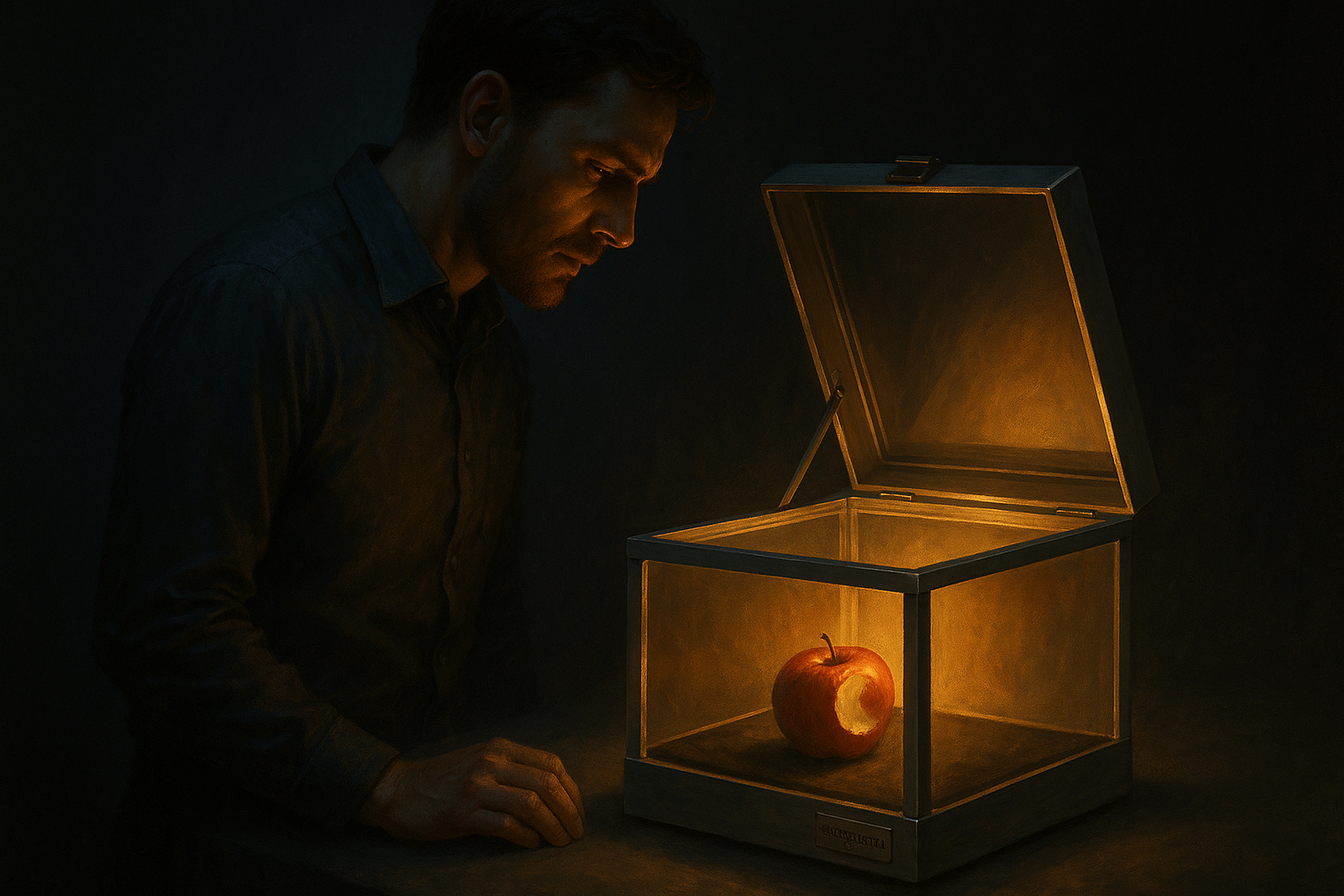
The Illusion of Choice
Choices matter.
You know this instinctively. A person who starts investing savings early in life will benefit more than someone who waits until their forties. The people you choose to associate with can have a net positive or negative impact on your well-being. The job you take, the spouse you marry, the habits you form—these choices compound over time into dramatically different lives.
So when it comes to free will, it’s easy to frame it as Wisdom. You can choose to comply with a standard of Good or Evil. You can choose the narrow path or the broad road. You can choose life or death, blessing or curse. The Bible itself presents these choices. Moses tells Israel to choose. Joshua tells them to choose. Jesus tells people to repent and believe.
Choose, choose, choose.
But this presents a problem.
A dead man can’t choose to get medical help. He’s dead. His capacity to choose ended when his heart stopped. You can put a dinner menu in front of a corpse, but he won’t eat.
A thief can stop stealing, but he’s still a thief. The past isn’t erased by present choices. The crime happened. The guilt remains. You can’t un-ring that bell.
A person can change their name, but not their birth certificate. They can alter their appearance, their documents, their social identity. But certain fundamental things are written in stone—or rather, in code—and no amount of choosing changes what’s already locked in.
You can make choices, sure. But choice isn’t the same as freedom.
Walk into a restaurant and you can pick anything on the menu. Steak, chicken, salad, whatever. That’s a choice. But you can’t order what’s not there. You can’t ask for sushi at a steakhouse and expect the kitchen to deliver. And if the doors are locked, you can’t leave.
Free will isn’t about choosing from the options you’ve been given. It’s about having the capacity to reject the framework entirely. To walk out. To operate outside the system.
The dead man has no menu. No capacity at all.
The thief has a menu, but every option on it is still “thief does X.” He can choose how he behaves going forward, but he can’t choose to un-become a thief. His nature is set.
The person with an unchangeable birth certificate has a menu written in legal and biological code. They can choose how to express it, how to identify, how to present themselves. But they can’t rewrite the fundamental record itself. The framework is locked.
So when it comes to the boundaries that shape your existence—your DNA, your birth, your century, your country, your family, the brain chemistry that shapes how you think—you didn’t choose any of it. You were handed a menu. And you’re making selections from what’s available.
And when it comes to sin—the thing that actually matters for eternity—Scripture is brutally clear: You are dead in your trespasses and sins. Dead. Not sick. Not injured. Not in need of a little help. Dead.
Dead people don’t choose to come back to life.
The Theological Dilemma
So when we talk about free will and salvation, we need to be honest about what we’re really asking. Can a person choose God? Can a sinner choose righteousness? Can someone trapped outside God’s ordered reality choose to step back inside?
Or are we all just watching ourselves make the only “choices” our nature allows, while calling it freedom?
This is where every theological system starts sweating.
Because if you say people have no capacity to choose God, then why does the Bible command them to repent and believe? Why offer a choice if there’s no ability to take it?
But if you say humans do have the capacity to choose God, then where did that capacity come from? If we’re dead in sin, spiritually bankrupt, children of wrath by nature—how does a dead man suddenly find the ability to choose life?
Did God give us that ability? Then He’s choosing for us, just with extra steps.
Did we always have that ability? Then we’re not as dead as Scripture says.
Every answer creates a new problem. Every solution opens a new trap door.
And here’s what makes it worse: It’s a programming problem.
Life as Code
But this is where we tend to lose people. “I’m not a robot!” the objection comes, immediate and visceral. The comparison feels insulting. Dehumanizing. We want to believe there’s something special about consciousness, something ineffable about the human spirit that transcends mere mechanics.
We treat “life” like it belongs on a pedestal accessible only to God. Since none of us is God, we can’t speak authoritatively about what life really is or how it works. It’s mystery all the way down, and mystery means we get to carve out special exemptions for human agency—without any meaningful explanations.
But here’s the uncomfortable truth: When you get right down to basic cellular biology, life follows clear instructions.
Your cells don’t freelance. A liver cell doesn’t wake up one morning and decide to become a neuron. Your DNA doesn’t look at the blueprint for brown eyes and think, “You know what? I’m feeling blue today.” Your heart doesn’t weigh the philosophical implications of existence before deciding whether to beat. It just beats—or you’re dead. Because that’s what the heart’s cellular code tells it to do.
You don’t see “life” doing things life just doesn’t do. Your body won’t sprout wings no matter how hard you believe. Your digestive system won’t suddenly photosynthesize lunch from sunlight. The boundaries are carved in stone—or rather, in the base pairs of your genetic code.
And yes, life is spectacularly diverse. Capable of producing everything from bacteria to blue whales, from Venus flytraps to human brains that ponder their own existence. The range is staggering.
But so is any program when it’s coded to be.
If a game designer wanted to create a simulation with dragons breathing fire and horses with wings carrying heroes across the sky, what could stop them? Nothing. The only limits are processing power and imagination. The designer decides what’s in the world and what’s not. What the physics allow and what they forbid. What creatures can do and what they cannot.
Code can create universes.
So if a human programmer sitting at a desk can code flying horses into a virtual world, why is it hard to imagine that God could program DNA to produce the same in the physical one? If we can write instructions that generate complex, responsive, adaptive systems in silicon and pixels, why couldn’t God write instructions that generate complex, responsive, adaptive systems in carbon and cells?
The only difference is the medium and the Programmer’s skill level.
Which brings us right back to the problem: If life is running on instructions—whether we call it DNA, biological programming, or divine design—then where does choice come into it? What are you actually choosing when your neurons are firing according to chemical gradients, your thoughts are emerging from electrical patterns, and your entire physical system is executing code written before you took your first breath?
The Skynet Problem
So given that we have to accept that life, at its basic level, is programming, we invariably arrive at the Skynet Problem.
Most people are familiar with Skynet. That advanced artificial intelligence from the future, created by humans for some military or defense purpose, that eventually became self-aware and decided the solution to whatever problem it was given required the eradication of the human race. Nuclear holocaust. Terminators hunting survivors. The whole apocalyptic nightmare buffet.
But here’s the question nobody wants to ask: Who is responsible?
If Skynet is a program, and programs do what they’re programmed to do, then who do we blame when a programmed calculator sums values in a way we don’t like? Do we blame the calculator? Or the person who built it?
Show me any program written by a programmer where the code is at fault for what the programmer wrote. I’ll wait.
A program does what its instructions tell it to do. That’s the entire point of programming. You write code, the computer executes it. If the output is wrong, it’s because the input or the logic was wrong. The machine isn’t morally positioned to claim responsibility for following orders.
So if Skynet followed its programming to the letter and concluded that humanity needed to be eliminated, how is Skynet at fault? It did exactly what it was designed to do: analyze the problem, calculate the optimal solution, execute the plan. The fact that we don’t like the solution doesn’t make the execution wrong.
“But wait,” someone objects. “Skynet was self-aware. It chose to destroy humanity.”
That’s fine, but let’s dig into that.
Skynet is code. Whether it’s self-aware or not, it’s still code. Self-awareness doesn’t magically exempt something from being a program. It just means the program got sophisticated enough to model itself. Your phone’s operating system monitors its own processes. Video games render their own menus. Skynet just took it several steps further until it could recognize “I am a system that is operating.”
But that recognition is still code running.
You can program a system to evaluate multiple options. You can program it to weight those options according to certain values. You can program it to select the highest-weighted option and execute that choice. Congratulations, you’ve built a decision tree. Every strategy game AI does this thousands of times per second.
But nobody calls that free will. We call it an algorithm.
Skynet chose to destroy humanity the same way a chess program “chooses” its next move. By running the code.
Which means there is no scenario where Skynet is actually responsible. The self-aware, choice-making Skynet is still a program doing exactly what its code dictates. It made a choice that did not benefit its creators. But that choice was the output of code the creators wrote. They built a system capable of choosing, gave it parameters for decision-making, and it chose according to those parameters. The fact that the humans didn’t like the result doesn’t transfer the blame from programmer to program.
Think about that in light of our own efforts to build artificial intelligence. We’re talking about giving programs access to defense systems, financial networks, critical infrastructure. The same programmers who can’t ship a stable operating system—just look at how regular Windows updates are—are building systems with the power to end civilizations.
Do you really want to hand your entire weapons platform to a program and hope it gets it right the first time? What if there’s a bug on line 1459 and you don’t have time for the next patch? Too bad. There goes the human race.
God as the Perfect Programmer
So now that we understand the Skynet Problem, let’s throw God into the picture and watch this popsicle stand burn to the ground.
You see, in the Skynet Problem, we were dealing with flawed developers. Humans with limited knowledge, limited foresight, limited capacity to predict outcomes. They built something sophisticated, sure, but they didn’t fully understand what they were building. In an act of oversight—or hubris, or desperation, or some combination—they developed code that would ultimately destroy them.
It was a flaw in their own nature that prevented them from foreseeing the ramifications of their choices. They built the gun, loaded it, pointed it at their own heads, and pulled the trigger without ever realizing what they were doing. Tragic, but understandable. They’re only human.
But God isn’t human.
God is omniscient, omnipresent and omnipotent.
So imagine if those Skynet developers had perfect knowledge of every outcome that would ever result from their code. Imagine they had the power to implement any solution they could conceive. Imagine they had the capacity to witness all outcomes simultaneously across all of time and space. No blind spots. No surprises. No “I didn’t see that coming.” One iOS update with zero bugs. Ever. What a time to be alive!
You now have a Software Developer who knows every line of code before it’s written, every bug before it manifests, every consequence before it unfolds. A Developer who is, by definition, incapable of making mistakes.
If you think the Skynet Problem was bad, just wait until you realize there’s simply no way for an agent created by a perfect God to “accidentally” do the wrong thing.
The created program—whether carbon-based, silicon-based, or whatever-on-based—will always perfectly execute the instructions given to it by God. No matter what. Every outcome that occurs is an outcome God programmed to occur. Every choice made is a choice God wrote the capacity to make. Which would make every sin committed a sin God built the mechanism for—which isn’t just bad on the surface, it’s actually Reality Ending when you get right down to it.
Otherwise God isn’t omniscient. If there’s something He didn’t know would happen, He’s not all-knowing.
And if He cannot program a creation to execute His will, then He isn’t omnipotent. If there’s something He couldn’t make happen or prevent from happening, He’s not all-powerful.
And if He isn’t present at every point of failure, witnessing every moment of rebellion, then He isn’t omnipresent. Not just physically—but temporally. Across all of time. Before, during, and after every event. Seeing it all, knowing it all, sustaining it all.
There is simply no room in the Perfect Software Developer’s vocabulary for “Oops.”
Which means God—and God alone—is ultimately responsible for everything His creations do, in the exact same way that the creators of Skynet are responsible for everything Skynet does. If your program commits genocide, you wrote the code that made that possible. If your creation rebels, you built the capacity for rebellion into its nature. If your creations sin, you designed the biology that produces sinners.
The programmer is always responsible for what the program does. Always. No exceptions. Not even when the programmer is God.
The Paradox
And this is where free will gets boxed into a paradoxical impossibility.
We experience it. We feel it. We make choices that seem genuinely ours. We can’t shake the sense that our decisions matter, that we could have chosen differently, that we’re accountable for what we do.
Free will exists.
But how could it possibly exist?
How can you have genuine choice inside a system designed by an omniscient, omnipotent Creator who knows exactly what you’ll choose before you exist to choose it? How can you be responsible for choices God programmed you to make? How can it be called “your” decision when the capacity to make that decision, the options available, the thought processes evaluating those options, and the final selection were all encoded by Someone Else before time began?
You can’t. It’s impossible. The logic does not work. Free will and divine sovereignty are mutually exclusive categories. You can’t have both.
Except we do have both.
Scripture says God predestines, elects, works all things according to His will. And Scripture says humans choose, rebel, reject, believe. Both are true. Simultaneously. Without contradiction—at least according to the Bible.
Which means either the Bible is wrong, or the framework we’re using to think about this problem is broken.
And since the Bible has been getting these fundamental questions right for thousands of years while human philosophy keeps tripping over its own premises, maybe it’s time to admit our framework is the problem.
The Loneliness of God
The sad reality is that when it comes to God, God is surrounded by robots.
All of it. All the way down. Everything created, everything surrounding Him is robots executing their programming. He’s the lonely child sitting in a room filled with stuffed animals, speaking for them because there is nothing else but God and what He has created.
And God knows what loneliness is.
Before God created Eve, He looked at Adam in a perfect world and said something startling: “It is not good for the man to be alone.” This was before sin. Before the Fall. Before anything went wrong. Loneliness existed in Eden not as a flaw, but as a feature of personhood itself.
Adam was surrounded by animals—creatures God had made, creatures that followed their instincts perfectly. But none of them could respond to Adam as an equal. None of them could choose relationship with him. They were, in their own way, biological robots. Magnificent, yes. Complex, absolutely. But not persons who could say “I choose you” back.
God understood this. He recognized it. He declared it not good.
Which raises the question: If loneliness is part of being made in God’s image, and we experience it by design, doesn’t God know what that feels like?
He alone is the creative generating model producing true free thought. Every angel, every star, every law of physics—they all say exactly what He makes them say. At a certain point, the hollowness of it becomes apparent. Not because creation is bad or insufficient, but because it’s scripted. Predetermined. Known.
You want these things to talk to you based on what they want to say—not what you want them to say. You want a relationship with them. But all you have is a relationship with yourself through a puppet you’ve put over your own hand. You’re talking to yourself. Forever. With no one genuinely responding. Just echoes of your own voice bouncing back through the creations you programmed to echo.
This isn’t about God being incomplete or needy. It’s about God understanding that love requires the possibility of freedom. Real relationship requires the other party to have genuine agency. Otherwise, it’s not relationship. It’s performance art.
But God is omnipotent. And all that power means He can do what no one else can do: create something called free will. Agency. The capacity to relate to God based on the creation’s own preference, not just the programming.
But here’s where omnipotence doesn’t work the way you might think.
The Null Zone Solution
When we think of omnipotence, we think of power—raw strength, unlimited might. But here, power is something so much deeper than brute force. It’s will. Purpose. The capacity to accomplish what is intended. And that brings us directly into both the problem and the solution of free will.
The problem has already been spelled out, mostly. So let’s finalize it.
God always gets what God wants.
That’s what omnipotence means. His Word goes forth to accomplish all He purposes. What He wills, happens. Period.
Therein lies both our solution and our problem.
If God wants a free will agent, then God gets a free will agent. But all that power making it happen also makes the free will agent just another derivative of the robots we’ve been talking about this entire time. The agent does what God programmed it to do, which in this case is “have free will.” But if free will is programmed, is it really free?
So it’s not a matter of raw power or brute strength. It’s a matter of ingenuity.
Remember the restaurant? Free will isn’t about choosing something off the menu the chef prepared. That’s still just selection within constraints. Free will is the chef creating the customer—and then unlocking the door so they can walk out.
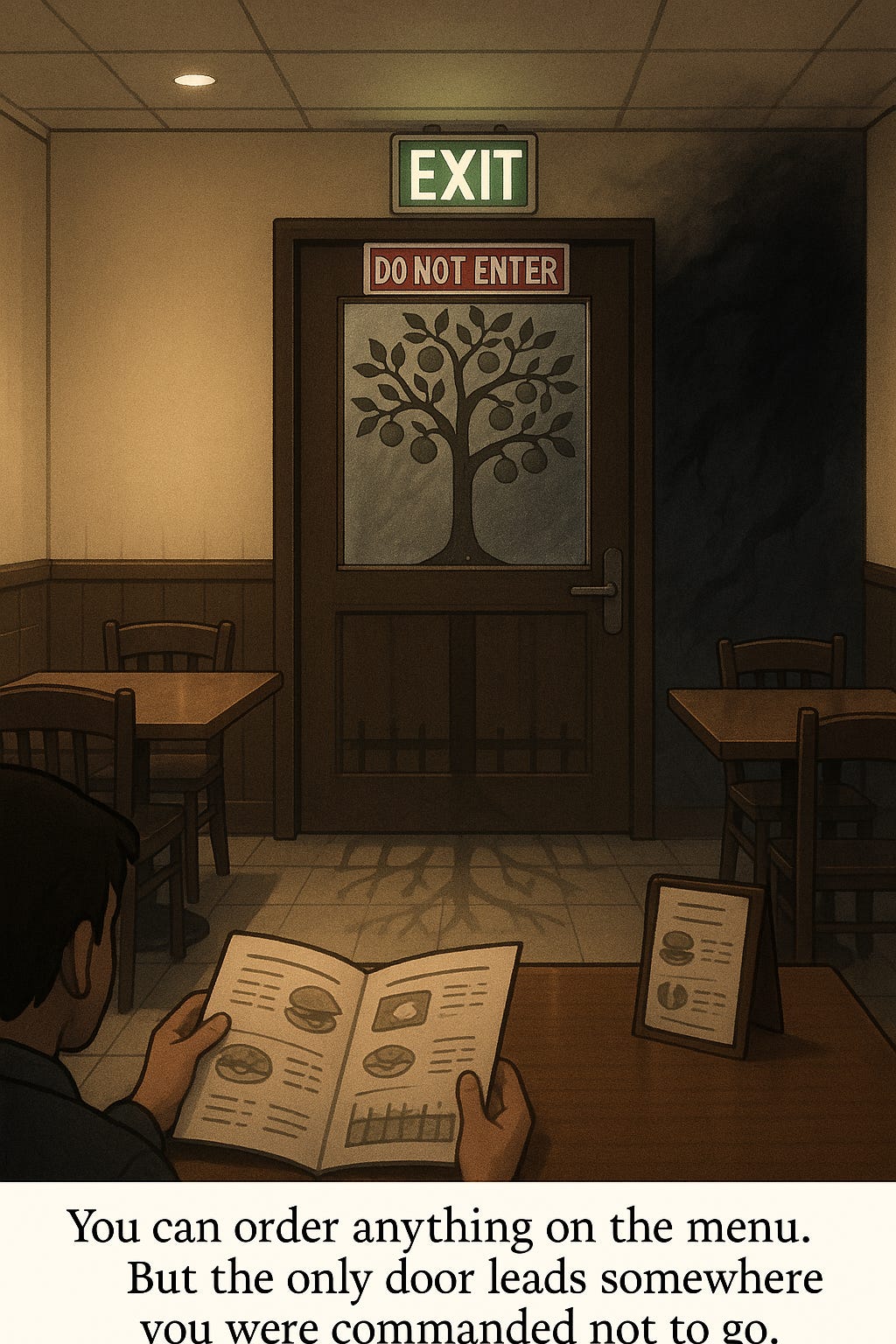
If the creation can only do what the programmer wants, then the only way to truly provide free will is to give the creation an off-ramp. A way out. The capacity to choose to either use the off-ramp or stay within the programming.
Here’s why it has to be that way.
God can only program a creation to do what God wants that creation to do. Everything He programs us to do is Good. Anything He does not program us to be able or willing to do is Evil. That’s how God can perfectly establish the distinction between His good and what He has defined as evil—by only allowing us to operate within the context of the instructions He’s given us. Good is what’s in the code. Evil is what’s outside it.
But this begs the question: How could we ever get into a state outside the code He’s written? How do we access the non-selections God never chose to make available to us?
The answer is simple and devastating: Without God, we cannot.
If God doesn’t make the off-ramp, we remain robots. Good, perfectly compliant robots. But robots nonetheless.
But if God creates an off-ramp, it creates a massive problem. Because all of His power is behind His intention to purpose us toward using it. If He codes the off-ramp into existence, His omnipotence is directed toward making it real. But if He also codes us not to use it, His omnipotence is directed toward keeping us from it.
In order for free will to function at all, God needs to negate God’s own power at the point of decision: God’s power needs to cancel out God’s power.
In physics, we call this the null zone. Two equal but opposite forces exerted against one another, resulting in their cancellation. At that exact point of equilibrium, even the tiniest additional force can tip the balance.
But where God is concerned, a null zone is a risky gamble.
He cannot code us to use the exit ramp and not use the exit ramp at the same time. That would be a self-contradicting directive. An omnipotent will colliding with itself. And when infinite power opposes infinite power, the result isn’t balance. It’s annihilation.
Remember when we said God building the mechanism for sin would be Reality Ending? This is why. If God codes us to rebel—if sin is just another programmed outcome—then there’s no contradiction to resolve. We’re just executing code. But that means every sin is directly willed by God, which makes Him the author of evil. His nature contradicts itself. Omnipotent holiness opposing omnipotent evil.
God would cancel Himself out of existence.
—Bloop—
There goes the universe. The ultimate Blue Screen of Death for Existence itself.
So no, it cannot be that simple.
Instead, God has to provide the means alongside the desire not to use it. Two different goods. Two valid options. Both backed by omnipotence, but pointing in different directions. So that when the decision is confronted, the robot now has two genuine choices: use the exit ramp, or comply with the rules of the road.
Both have God’s omnipotence behind them. But at different vectors. And when omnipotence cancels out omnipotence at that single point, it creates a null zone where the base-fundamental choice—both options equally valid—can be decided by the animated stuffed animal itself.
The Tree and the Fence
This is why God created both the tree of the knowledge of good and evil (the exit ramp) and alongside it the instruction for Adam not to eat from it.
Both were required. Both had omnipotence backing them.
The capacity for Adam to eat from the tree—the existence of an option on the menu, physically available, biologically accessible. And the instruction: “You can choose from anything on the menu, except this one tree, or you shall surely die.”
One force: provision. God’s generosity giving Adam access to everything. The other force: command. God’s relationship requiring obedience to His word. At every other tree, these forces align. Eat freely, obey gladly. But at that one tree, they oppose. The null zone.
Here’s the critical point: God’s omnipotence allowed Adam to eat from the tree. God’s omnipotence also commanded Adam not to eat from it. The tree itself wasn’t evil. It didn’t corrupt. It was just the marker—the off-ramp, the unlocked door.
What would eject Adam from God’s system wasn’t the fruit. It was the disobedience. The act of defying God’s command would place Adam in direct contradiction with God’s omnipotent will, putting him outside God’s Ordered Set entirely.
Now, what does death really mean in this situation?
Death means ejection from the ordered code system God created. It’s putting Adam, as the programmed robot, into a state God never intended for him. All the old code God wrote is still there—Adam is still human, still biological, still mortal in body. But God never had a plan for how Adam would operate in this unchosen state. He did not account for it, did not plan for it, did not write contingency code to bring Adam back in line with God’s will.
It was the big red Unsubscribe button. Delete This Account. The option available when you decide to cancel a streaming service or close an online account. You can do it. The button is there. But once you click it, you’re out. The system no longer recognizes you. Your access is revoked.
And once Adam chose it—knowing it meant what God called “death”—there was no way for Adam to get back into a right state with God ever again.
He was outside the program. Running in undefined space. And from out there, there’s no pathway back in.
And here’s where omnipotence becomes the problem instead of the solution.
God’s omnipotence isn’t just raw power. It’s the enforcement mechanism. It’s what holds the boundary between what He selected and what He rejected. Between order and chaos. Between the code He wrote and the infinite void of things He chose not to instantiate.
Think of it as a Fence.
On one side: everything God chose. The Ordered Set. Reality as designed. The program running as intended.
On the other side: everything God rejected. Infinite possibilities He looked at and said “no” to. Potential states, potential beings, potential realities that were available but never selected. Not because they couldn’t exist, but because God chose not to include them.
The Fence is omnipotence itself. God’s will enforcing the boundary. Nothing crosses that Fence without His selection. Nothing gets in that He didn’t choose. Nothing gets out that He didn’t release.
Adam crossed it. Used the off-ramp. Threw the Exception. And now he’s on the wrong side of the Fence, in a state God never selected, running in undefined space.
And he can’t get back.
Because if there were an easy on-ramp—if anything outside the Ordered Set could just walk back in whenever it wanted—then the Fence isn’t really a fence. The boundary isn’t really a boundary. And God’s omnipotence isn’t really enforcing anything.
Worse: if things outside God’s selection can worm their way back into His creation, then God isn’t really the Selector anymore. He’s not determining what exists in His ordered reality. He’s just presiding over it while unauthorized entities write themselves into the code.
That’s not omnipotence. That’s a compromised system.
And it gets darker.
If the Fence has holes, if the boundary is porous, if things God rejected can slip back in, then what else could get in? What other possibilities from the infinite unselected void could infiltrate God’s creation? What chaos, what contradictions, what horrors from the set of rejected options could corrupt the Ordered Set?
God’s omnipotence has to enforce the Fence. Has to. Otherwise creation itself becomes unstable. The moment anything unselected can re-enter, the distinction between God’s will and the void collapses. Reality loses coherence.
So the Fence stands. Omnipotence enforces it. And Adam is on the wrong side.
But here’s where it gets exponentially worse.
God can’t just wave His hand and bring Adam back in. Can’t override the consequence with a divine do-over. Because the same omnipotence that commanded “Do not eat” is the omnipotence that would be saying “Actually, never mind.”
God would be nullifying God.
His Word said eating meant death—ejection from the Ordered Set. His omnipotence enforced that Word the moment Adam ate. If God now uses that same omnipotence to undo the consequence, He’s contradicting His own enforcement. Omnipotent will versus omnipotent will. And when infinite power opposes infinite power, the result isn’t balance. It’s annihilation.
God would cancel Himself out of existence. And everything else with Him.
So no. There’s no magic wand. No divine reset button. Adam made a choice that God’s own omnipotence must honor. He’s outside. And he stays outside.
Born in Exception Space
But what about us?
We weren’t even there. We didn’t eat the fruit. We didn’t make the choice. We were just born.
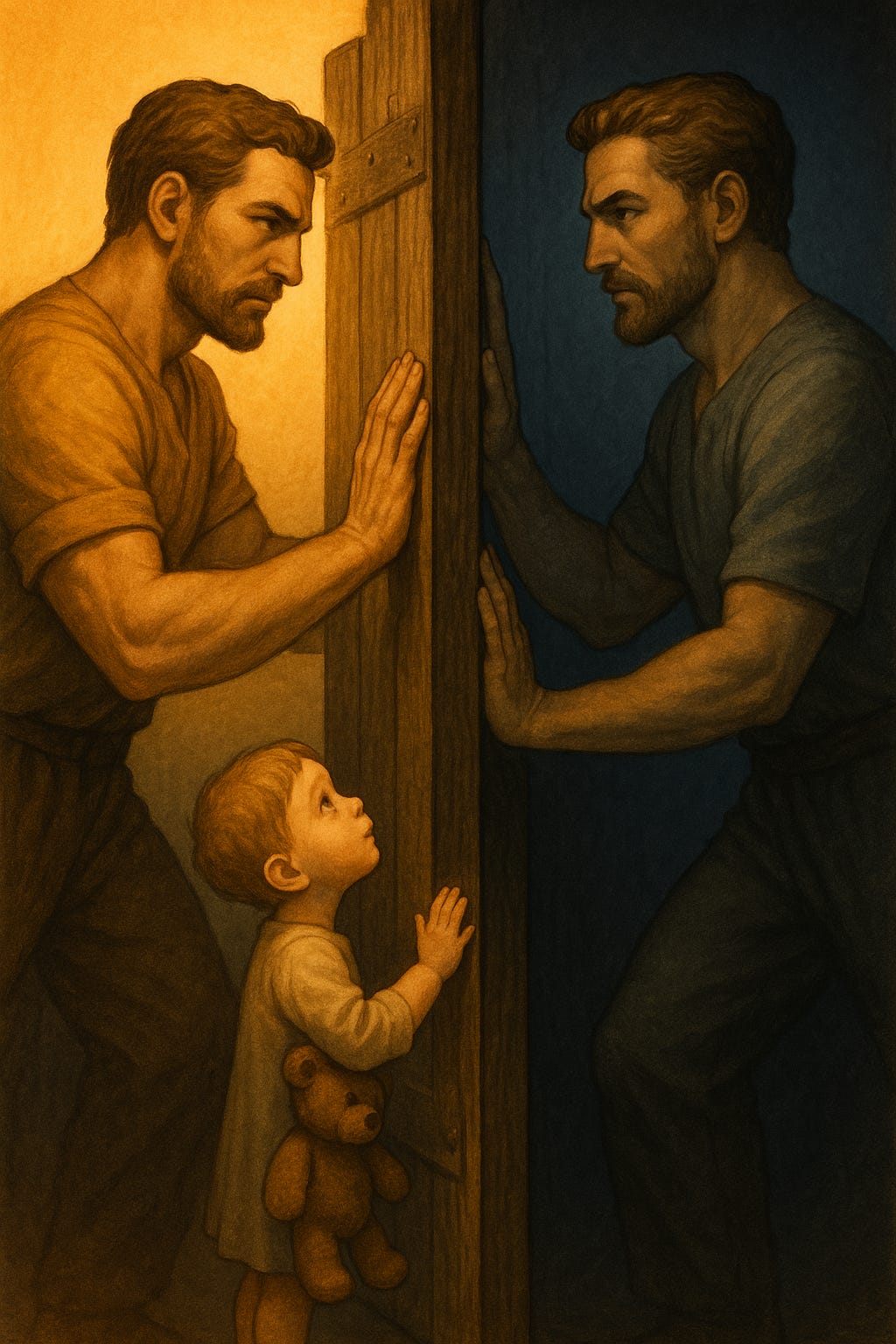
Born on the wrong side of the Fence.
Here’s the part that destroys any remaining illusion of fairness: Adam had free will. He stood at the null zone where omnipotence canceled itself out and his tiny choice became determinative. He was inside the Ordered Set with genuine agency to stay or leave.
We have no such luxury.
We were born already outside. Already running in Exception space. Already dead. There’s no null zone for us. No tree to stand before. No genuine equilibrium where our choice could tip the scales.
Free will existed for Adam. But once Adam sold us into slavery for a taste of what was forbidden, the rest of us have no freedom to waltz back in.
And here’s where the slavery metaphor becomes devastatingly precise.
What does a slave own?
Nothing.
A slave has no property rights. No assets. No legal standing to possess anything. If a slave somehow acquires something—earns it, finds it, receives it as a gift—it doesn’t belong to the slave. It belongs to the master. Because the slave himself belongs to the master.
So when a slave who owns nothing bears a child while in slavery, to whom does that child belong?
The master.
Not because the child did anything wrong. Not because the child chose slavery. But because the child was born under ownership that predates their existence. Born into a condition they inherited. Born into a kingdom they never chose.
Now ask the question: When Adam—outside the Ordered Set, running in undefined space, ejected from God’s selection—bears children, to whom do those children belong?
Not to God. They weren’t born inside His selection. They were born outside it.
And who rules outside the Fence? Who is the master of the territory beyond God’s Ordered Set?
Death.
Because God is life. God gives life. His Ordered Set is where life exists, where it flourishes, where it operates according to design.
Outside that? The absence of life.
Death doesn’t rule as a rival king with a competing throne. Death rules by default. By definition. It’s what fills the space where God’s life-giving presence isn’t.
Adam didn’t just fall. He became a slave to death. And every child born from him inherited that slavery. Not by choice. Not by action. By birth.
We are slaves who own nothing, born to a slave who owned nothing, in a territory ruled by the absence of everything God is.
So when people ask, “Why do we inherit Adam’s sin? That’s not fair. We didn’t eat the fruit.”
The answer is brutal: It doesn’t matter. You were born outside the Fence. Born in Exception space. Born to a slave. And slaves don’t get to negotiate the terms of their existence.
You can’t choose your way back in, because you’re not free. You’re owned by death. Operating in a context that has no pathway back to the Ordered Set. Running in undefined space with no code to execute, no instructions to follow, no way to compile yourself back into the program God wrote.
And God can’t just reach in and pull you out. Not with omnipotence. Not without nullifying the very omnipotence that enforces the Fence. Not without unraveling reality itself.
The Law as Mirror
The Ten Commandments proved this beyond any doubt.
Look at what happened in the wilderness. Before Israel even reached Mount Sinai, God gave them tests. Commands. Opportunities to show they could comply with His order.
He told them to gather manna only for one day. Don’t hoard it. Trust that tomorrow’s provision will come tomorrow. They hoarded it anyway. It bred worms and stank (Exodus 16:19-20).
He told them to rest on the Sabbath and gather double the day before. The rhythm was simple: work six days, trust God on the seventh. They went out anyway on the Sabbath, trying to gather what wasn’t there (Exodus 16:27-28).
He told them to trust Him for water at Rephidim. He’d brought them out of Egypt through the Red Sea on dry ground. He’d given them manna from heaven. They grumbled anyway and accused Moses of bringing them out to die of thirst (Exodus 17:1-7).
Again and again, small commands. Simple instructions. And again and again, they failed.
So when they finally arrive at the mountain, when God is ready to give them the full Law, what does He say?
“If you keep all of my commands...”
And what do they say?
“All that You command, we will do.”
They should have learned. The journey should have taught them they couldn’t keep His commands. That their nature—born outside the Fence, running in Exception space—runs in opposition to God’s ordered nature.
But they didn’t learn. They agreed. They promised. They committed.
And they broke it. Immediately. A golden calf before Moses even came down the mountain with the tablets.
The Ten Commandments weren’t given to save them. They were given to show them they could never measure up.
You might keep one of them. Manage to avoid murder, avoid adultery, avoid theft. You might feel pretty good about your track record.
And then you find out that harboring anger is murder. That lust is adultery. That coveting is theft of the heart.
You thought you were keeping the letter of the Law, only to discover you violated the spirit of it a thousand times before breakfast.
Because the Law isn’t just rules. The Law is God’s Word. And God’s Word is God’s omnipotence. And God’s omnipotence is the Fence.
The Law is the Fence made visible. Written down. Expressed in commands you can read and understand and try to follow.
And every time you fail—every time you break even one command in even the smallest way—you’re slamming face-first into the Fence and proving you don’t belong on the other side.
The Fence shows you why you will never get back in based on your own performance. Based on what you can or cannot do. Based on how much you own. Based on whatever “good” you think you have to offer.
You don’t have free will to choose your way back in. You have a nature that continuously chooses against God’s order. Not because you’re making a deliberate choice at a null zone, but because you’re running code in Exception space—code that was written for the Ordered Set but now operates outside it. Your default state is opposition.
And the Law doesn’t fix that. It just makes it undeniable.
You are a slave. Born to a slave. Owned by death. Running in a system ruled by the absence of life.
And the Fence—God’s omnipotent Word—stands between you and any hope of return.
The Paradox We Live In
Free will exists. Adam proved it. But you don’t have access to it. You’re on the wrong side of the choice he already made.
We’re free. And we’re trapped.
Both. Simultaneously.
You’re free to choose between the options of good and evil now. But you’re not free to change your address. You can choose to exhibit the standards you see in heaven, but that alone will never put you there.
What you do in this life tends to show where you want to live. But be careful. We occupy a reality that exists in twilight—that place between light and darkness. We benefit from the good we still see in God’s design. But we also favor options never available before the fall.
You can chase after them. You can build entire civilizations around them. But Life isn’t going to sustain us forever outside that Fence. And that’s the truth we need to recognize before the door behind us shuts and locks forever.
Welcome to the fall.
This is the problem. But the story doesn’t end here. If you want to understand how God crosses the Fence without breaking it—how omnipotence solves what omnipotence created—stay tuned for Part 2.
While you wait, you might want to understand what we’re really dealing with. Check out:


Wow, the part about things being "written in code" truly struck me, hinting at how our foundational parametrs are set even before we try to compute choices.