

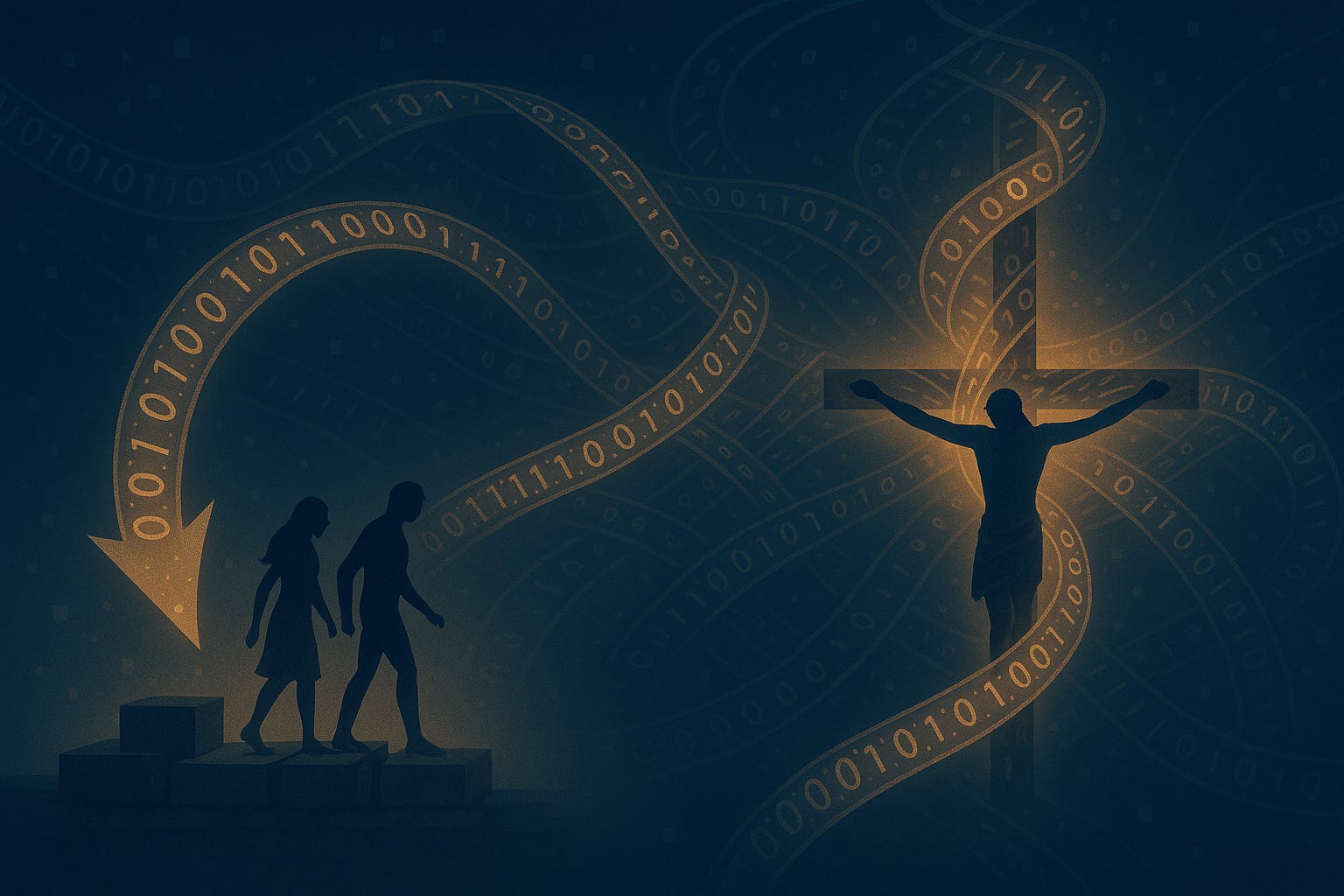
Schrödinger’s Free Will
Part II: The Easter Egg Trap
Schrödinger’s Free Will
Part II: The Easter Egg Trap
For readers just discovering this series: Part I is necessary. It’s the decoder ring through which Part II as a map will make sense. Terms like “the Fence,” “the Ordered Set,” and “Exception space” are defined there. Reading the end from the beginning is like playing chicken with a game of Telephone.
Part 1 left us in a predicament.
Adam’s choice triggered God’s Word—”You shall surely die”—and that Word executed. Humanity was ejected from God’s ordered design into the unhandled exception—the space outside His selection. Outside the Fence that separates life from death. Dead in our sins. Owned by death. And God can’t simply reverse what His Word carried out. Omnipotence can’t oppose omnipotence without detonating reality itself.
No earthly power can get us back in — not human effort, not religious striving. The Fence is omnipotence itself, and we’re on the wrong side of it.
Daniel in the lion’s den captures this exactly.
He broke Darius’ law, and not even the king who issued the decree could undo it. Darius spent a full day trying to find a loophole—any way to rescue Daniel without contradicting his own word. He couldn’t. The stone rolled over the mouth of the den, and no human authority could reverse what the law had set in motion.
And Daniel was alone with the breathing of lions.
Does he get eaten? Does he die?
We know how this story ends. But pretend you don’t. Pretend this is your story and the ending hasn’t been written yet.
Darius loved Daniel. Scripture tells us what happened before Daniel ever hit the floor of that den:
Then the king, when he heard these words, was much distressed and set his mind to deliver Daniel. And he labored till the sun went down to rescue him. (Daniel 6:14)
Darius spent the entire day searching for a way out—some mechanism in the law, some precedent, some legal pathway that might save his friend without breaking his own decree. He labored until sundown.
He found nothing.
Then these men came by agreement to the king and said to the king, “Know, O king, that it is a law of the Medes and Persians that no injunction or ordinance that the king establishes can be changed.” (Daniel 6:15)
The satraps reminded him: the law can’t be changed. A king who negates his own decrees ceases to be a king. His word would mean nothing. His authority would collapse.
So Daniel went into the den. And Darius spent the night in anguish:
Then the king went to his palace and spent the night fasting; no diversions were brought to him, and sleep fled from him. (Daniel 6:18)
Darius wasn’t trying to issue a new decree to override the old one. He knew that wouldn’t work. He searched the existing law—looking for something already there, some provision already established that might provide a way out.
He came up empty. Because he was just a man. He didn’t know the end from the beginning. He got blindsided by the satraps’ scheme and had no pre-existing mechanism to save Daniel.
But God isn’t Darius.
Remember the former things of old; for I am God, and there is no other; I am God, and there is none like me, declaring the end from the beginning and from ancient times things not yet done, saying, “My counsel shall stand, and I will accomplish all my purpose.” (Isaiah 46:9-10)
God declares the end from the beginning.
Not the beginning from the end. Not figuring it out as He goes. He sees the end first, then builds backward to the beginning. Every piece placed with full knowledge of where everything is heading.
Think about what that means for creation.
God spent five days building a universe so vast it staggers comprehension. Billions of galaxies. Trillions of stars. Planets orbiting suns so distant their light takes millions of years to reach earth. Details no human eye would ever see. Complexity no human mind would ever fully grasp. All of it crafted with intention. All of it declared good.
Then He creates Adam. Places him in the garden. Gives him one command.
And Adam breaks it.
Now ask yourself: Does it make sense that a God who declares the end from the beginning—who built unfathomable complexity into every corner of the cosmos—would overlook what was about to happen in His own garden? That He’d craft a universe of incomprehensible detail but miss the obvious? That He’d account for the orbital mechanics of planets around stars light-years beyond Adam’s perception but fail to account for what Adam would do next?
Either God is the kind of being who gets blindsided by human choices and scrambles to fix problems after they occur—in which case Isaiah 46 is a lie and we’re all in trouble for much bigger reasons than the fall.
Or God is the kind of being who declares the end from the beginning and builds accordingly—in which case He knew exactly what would happen in Genesis 3 when He was building Genesis 2.
You can’t have it both ways.
And if God knew what was coming, you’re left with only two possibilities: Either He saw the fall approaching and didn’t bother to prepare—in which case the God who cared about the orbital mechanics of distant stars didn’t care enough to plan for His own children. Or He prepared for it before it was anyone else’s idea.
The only question is: Where did He hide the mechanism?
Darius searched existing law to save Daniel. He found nothing—he hadn’t prepared because he couldn’t have known.
God knew.
So if salvation exists, it wasn’t invented after the fall. It was built into the system before the fall—a mechanism established in Genesis 1-2, sitting dormant, waiting for Genesis 3 to activate it.
Just like Darius needed existing law to save Daniel, God needed existing structure to save humanity. Not a new decree that would contradict His Word—omnipotence opposing omnipotence—but something already there, already written, already compiled.
The question isn’t whether God prepared for the fall. He declares the end from the beginning. Of course He prepared.
The question is: What did He build? And where did He hide it?
Genesis 2 – The Bricks
Genesis 2 existed before Genesis 3.
That sounds obvious. But stay with it.
Everyone focuses on Genesis 3 — the tree, the serpent, the fruit, the fall, the curse. That’s where the action is. That’s where everything went wrong.
But Genesis 2 came first. God was building something before there was any sin to fix, before any curse to reverse, before any problem to solve.
What was He building? And why?
The Deep Sleep
So the LORD God caused a deep sleep to fall upon the man. (Genesis 2:21)
This is the first surgery in history, and the patient is unconscious.
Adam doesn’t assist. He doesn’t observe or contribute. He’s completely passive — the work happens to him, not by him.
God could have formed Eve from the ground the same way He formed Adam, but He didn’t. He put Adam under first. He made the creation of Eve something Adam had no part in producing.
Why design it this way? Why code unconsciousness into the process when it wasn’t necessary?
The Opened Side
And while he slept took one of his ribs and closed up its place with flesh. (Genesis 2:21)
God opens Adam’s body, reaches in, and takes something from within.
There’s no way around it — this is a wound. Adam’s side is opened, something is removed, and then the wound is closed. A wound that produces life. A cutting that leads to creation. Loss that becomes gain.
This happens before anything has gone wrong, before any sacrifice is needed, before blood carries any theological weight at all. God builds a wound into the origin of humanity.
A strange detail to include if it’s just about making a woman.
The Bride’s Origin
And the rib that the LORD God had taken from the man he made into a woman and brought her to the man. (Genesis 2:22)
Where was Eve before this moment?
She didn’t exist — not somewhere else, not waiting, not pre-formed. And then she was. Her existence begins inside Adam, is brought out through the wound, and is formed into something new.
She didn’t climb into existence or earn her way in or choose to be created. It was done to her, through him.
Then the man said, “This at last is bone of my bones and flesh of my flesh.” (Genesis 2:23)
Bone of bone. Flesh of flesh. Complete identification. She isn’t merely like him — she’s from him. Same substance, same origin. What he is, she is.
One Flesh
Two become one. This isn’t poetry — it’s biology. One-flesh union is how new life begins. The man’s seed passes to the woman. The woman receives it. And from that union, something new comes into existence that didn’t exist before.
The transfer is one-directional. What the man carries, he gives. What the woman receives, bears fruit in her own flesh.
God designed union this way before there was any reason we can see. Before anything needed to pass from one person to another. Before new life needed to be brought forth from what looked like nothing.
The Command
And the LORD God commanded the man, saying, “You may surely eat of every tree of the garden, but of the tree of the knowledge of good and evil you shall not eat, for in the day that you eat of it you shall surely die.” (Genesis 2:16-17)
Every “you” in that sentence is singular in Hebrew. God gave this command to Adam alone, before Eve existed.
The command didn’t go to humanity in general — it went to the head. Adam received it directly from God, before Eve existed. Eve would receive it through Adam.
We know this because when Eve recounts the command in Genesis 3, she gets it wrong. God said, “You shall not eat of it, for in the day that you eat of it you shall surely die.” Eve’s version? “You shall not eat of the fruit of the tree that is in the midst of the garden, neither shall you touch it, lest you die.” She adds a prohibition God never gave and softens the certainty of death to a mere possibility.
The command passed through Adam and arrived at Eve altered — like a game of telephone. This is how we know the structure: Adam stands before God as the representative, the one who received the Word directly, the one accountable for it. Eve is joined to him, under his headship, sharing his standing.
The Pieces on the Table
So before Genesis 3 — before the serpent, before the fruit, before anything went wrong — God had already established:
A pattern of deep sleep, where the work happens to someone rather than by them
A wound in the side that produces life
A bride brought into existence through union with someone already there
Complete identification — bone of bone, flesh of flesh
One-flesh union, where two share the same status and fate
A head-body structure, where the representative’s standing determines the body’s standing
These are the components, the raw materials, the bricks.
The question is: What are they for?
If God declares the end from the beginning — if He sees where everything is heading before He lays the first stone — then none of this is accidental. Every detail is load-bearing.
So what was He building?
We’ll need Genesis 3 to find out.
The Evidence
Genesis 3 brings us to the fruit and the fall.
Here’s what most people assume: the fruit had some inherent property — spiritual poison, forbidden knowledge, magical corruption — and eating it triggered the consequence. Eve ate, Eve fell. Then Adam ate, Adam fell. Two individual acts, two individual consequences.
But that’s not what the text says.
She took of its fruit and ate, and she also gave some to her husband who was with her, and he ate. Then the eyes of both were opened. (Genesis 3:6-7)
Eve eats first. Then Adam eats. Then — then — both their eyes are opened.
Not Eve’s eyes first. Both. Simultaneously. After Adam eats.
The Hebrew is telling here. The word we translate as “then” is the ordinary Hebrew connective, but scholars note that when attached to this verb it carries resultative force — “immediately,” “right away,” “at that moment.” The grammar shows urgent immediacy after Adam ate.
Look at the sequence: Eve takes the fruit — connective — she eats — connective — she gives to Adam — connective — he eats — connective (resultative) — both their eyes are opened.
After Eve eats, what follows? Just another action. She hands the fruit to Adam. No result. No consequence. No shift.
After Adam eats? Immediate result. Both fall. The mechanism fires.
The Problem
This creates a theological problem.
If the fruit had inherent properties — if eating it triggered the fall — then Eve should have fallen the moment she swallowed. She ate first. She should have dropped first. But nothing happened to her. Not until Adam ate.
So what do we make of this? Does it mean the fruit wasn’t actually poisonous? Does it mean it worked slower on women? Is that really the inference we want to draw — that forbidden fruit has a gender-based delay?
A naturalist studying this would find no explanation. If you examined that fruit, you’d likely find nothing to demonstrate it was anything but a fruit “good for eating,” just as Eve observed. No toxin. No magical residue. Just fruit.
And yet the internal informational state of both Adam and Eve shifted the instant Adam ate. Something changed — not in the fruit, but in them. Both of them. Simultaneously.
What are we to do with this?
The Bricks Explain It
This is where two of our bricks begin to make sense of things.
The first brick: The command was to Adam.
Go back to Genesis 2:16-17. Every “you” is singular in Hebrew. God gave the command to Adam alone, before Eve existed. The prohibition, the warning, the consequence — all addressed to one man.
Eve wasn’t the target of that command. She received it secondhand, through Adam, imperfectly transmitted. When Eve ate the fruit, she wasn’t violating a command given to her. She was acting on a garbled version of a command given to her husband.
The Word that said “in the day you eat of it you shall surely die” was aimed at Adam. He was in the crosshairs. He was accountable.
And that’s exactly what we see. Eve ate — nothing. Adam ate — immediate fall.
The first brick explains why Eve’s action didn’t trigger the consequence.
But this naturally creates confusion.
If Adam was the target, and Adam fell when he ate, why did Eve fall too? Why did both their eyes open at the same moment?
This is where our second brick comes to our aid.
The second brick: They were one flesh.
Genesis 2:24 — the two become one. What affects one affects the other. Shared status. Shared standing. Shared fate.
So when Adam fell, Eve fell with him. Not because she ate the fruit, but because she was joined to him. His status change transferred to her instantly through the one-flesh union.
But wait — if they were one flesh, why didn’t Adam fall when Eve ate?
Because one flesh has a direction.
Adam was created first. Eve was brought out of him — bone of his bone, flesh of his flesh. The man gives to the woman, not the reverse. We saw this in the telephone game: the command didn’t flow from Eve to Adam, but from Adam to Eve. The conduit runs one way.
Biologically, the man’s seed passes to the woman. What the man carries, he gives. What the woman receives, bears fruit in her own flesh. The transfer is one-directional.
Adam is the federal head of the union. What he carries flows to her. What she carries doesn’t flow upstream to him. This isn’t arbitrary — it’s how systems work. A folder doesn’t poll its subfolders before deletion. A head doesn’t ask the body’s permission to fall. Structure has direction.
So when Eve ate, there was no mechanism for her action to affect Adam. The conduit doesn’t run that direction. Whatever she now carried couldn’t transfer to him.
But when Adam ate? The conduit was open. The head fell, and the one-flesh union instantly carried that fallen status to the body.
Both their eyes opened. At the same moment. Because the bricks finally had something to execute.
The Bricks Fired
Eve did not fall because the command was never to her.
But Eve fell because they were one flesh — and what affects the head will also destroy the body.
Two bricks. Both operational. Both load-bearing. And in Genesis 3, we watch them bear the weight.
This isn’t theology. This is architecture. The system executed exactly as designed.
The Trap
If you’re the devil, this is the awkward moment.
You studied God’s system. You found the structures — head and body, one flesh, the command that went to Adam alone. You isolated the body from the head. You approached Eve with a garbled version of a command she never received directly. You let Adam watch her eat and not drop. You used his love against him.
And it worked. Adam ate. God’s Word fired. Humanity fell. The mechanisms executed exactly as you expected.
You thought you had found vulnerabilities in God’s design. Exploits in His architecture. You thought you had cornered the Almighty with His own system.
But God declares the end from the beginning. He knew what you would do before you existed. He knew which mechanisms you would exploit, which structures you would twist, which weaknesses you would target.
And He built them anyway.
Not because He missed your play. Because He was planning to use the same mechanisms you exploited — in the opposite direction.
You didn’t find vulnerabilities. You found bait.
And like a terrifying long game of Final Destination, God sent His Word against you. These basic bricks you thought you were exploiting? They were always meant to be the downfall of your master plan. You wanted to destroy mankind made in God’s image. But God used your own move to bring about something far worse for you — not just redemption, but elevation. Humanity raised higher than you ever stood. Higher than that archangel you once were.
You tried bury Man. God used your attempt to lift them above you.
The bricks that carried sin in are the same bricks that will carry sin out. The head-body structure. The one-flesh union. The transfer that flows one direction.
You used them to trap humanity.
And with Final Destination-like force, God’s bricks executed and trapped you.
Here’s how He did it.
The Not Good
In Genesis 2, God looked at Adam and said something He hadn’t said about anything else in creation: “It is not good.” A problem that needed fixing, a deficiency in an otherwise perfect world.
And what followed? God put Adam to sleep.
This is an outright foreshadow of death. The man was prostrate on the ground, unconscious, unaware, non-operational. He wasn’t participating in what came next. The work happened to him while he lay there like a body in a grave. And out of that picture of death came new life—Eve, the bride, brought forth from the one who was laid down.
Now watch what happens after the fall.
When Adam ate the fruit, something catastrophically Not Good happened. The head fell, the body fell with him, and humanity was ejected from God’s ordered design into Exception space.
And what immediately follows?
And the LORD God made for Adam and for his wife garments of skins and clothed them. (Genesis 3:21)
God made garments of skins, which means something was wearing those skins before Adam and Eve were. That animal was alive, and then it wasn’t. Its death provided the covering. This is the first blood sacrifice in Scripture, and God performed it Himself. The principle “without the shedding of blood there is no forgiveness of sins” (Hebrews 9:22) didn’t originate at Sinai—it was operational in Eden, the moment after the fall.
Notice that it still isn’t Adam who dies. The wages of sin is death, and Adam earned those wages. But Adam walks away wearing someone else’s skin. Something died in his place as a substitute.
In gaming, an Easter egg is hidden functionality that doesn’t trigger until the right conditions are met. It sits in the code the whole time, invisible, until you hit the activation sequence.
God buried an Easter egg in Genesis 2. When Adam was put to sleep, another life came forth. The mechanism was demonstrated before it was needed—deep sleep, opened side, new life emerging from what looked like death.
Then Genesis 3 happened. The conditions were met, and the Easter egg executed.
But the animal sacrifice was only the first execution, a preview. The mechanism was designed for something larger. The same pattern that produced Eve from Adam’s “death” would eventually produce a Bride from another’s death—not a picture, not a substitute animal, but the real thing. The one the whole system was pointing toward.
The Solution
We’ve been showing the tangible evidence that God was prepared in advance. Like a Final Destination force moving pencils and cords into position, the bricks were laid before the fall, waiting to execute. But we don’t yet have the big picture for what God is about to do — and more importantly, why.
The answer is simpler than you might expect. Just examine the conditions of the fall.
“If you eat of this tree, you shall surely die.”
In Part 1, we approached this from the hard reality that there is simply nothing we can do — like King Darius with Daniel — to set ourselves free from what Adam got us into. We’re outside the Fence. Dead in our sins. Owned by death. No human effort, no religious striving, no amount of good behavior can undo what God’s Word set in motion.
But unlike King Darius, God had a plan from the very beginning. And that solution involved fulfilling every word He spoke.
When I say every, I mean every.
Here’s why: Omnipotence cannot violate omnipotence, or we really do get a front row seat to a big bang. God’s Word said man would die. That Word executed. And God can’t simply retract it, override it, or pretend it didn’t happen. His integrity holds reality together.
So the only solution is not around the problem, not over it, not under it, not away from it — but through it.
Man has to die.
The Hero
While Satan was looking at that one-flesh union as an exploitable hack to trick Eve and kill Adam, God was watching the clips before Creation was even created.
And God had already said, “Not so fast.”
Because His solution to the problem of sin was to kill a man. Not just any man — a man who hadn’t violated the conditions of the fall. A man who wasn’t of Adam’s lineage through the male line, but still of his flesh.
The line runs from Adam through Eve, down through the generations, to Jesus.
Christ came through Eve’s line, not Adam’s federal headship. Born of a woman, but not of a man’s seed. He entered the human race without inheriting Adam’s fallen status, because the one-flesh transfer flows from the man, not to him.
He was fully human. Fully in Adam’s flesh. But not under Adam’s condemnation.
A loophole? No — a mechanism. Built into Genesis 2, waiting for activation.
The Game Design
To truly understand how salvation works, you simply have to understand how video games work.
Imagine the next big triple-A game. You pay $70, download it, install it, learn the systems, step out into a vast open world to explore all the wonders and mysteries of this strange new environment. You walk out the first door, a slime touches your foot, you fall down, die, Game Over — and the game is permanently disabled forever.
That game wouldn’t stay on shelves long.
People play games with the understanding that when Super Mario falls into a pit, gets hit by a koopa, is burned by a fireball, crushed by a spike, or falls into lava — even after three lives expire — the game can still be played again. The adventure never truly ends. Mario gets back up to start afresh.
Resurrection happens a billion times a day across millions of consoles and emulators around the world. And we’re the ones with a problem believing God resurrected His heroic Son?
The point is this: a well-designed game where everything is operating as intended results in the dead player character getting back up to continue the adventure. That’s how games are designed. Otherwise, they don’t sell.
Some may find video game analogies unserious for theology. The irony is thick: game code is far more rigorous than most theological arguments, by necessity. When logic fails in a program, it crashes — publicly, spectacularly, for all to see. Human arguments persist despite contradictions because our internal compiler is tuned for survival, not purity. We rely on a “you know what I mean” protocol that glosses over transmission errors, and — as the game of Telephone regularly demonstrates — other people’s compilers do not know what you mean. Worse, participants routinely mod their own terms mid-runtime, patching definitions to protect their priors while the discussion forks into parallel mental universes where everyone’s “winning” but no one’s communicating.
If you object to Mario illustrating resurrection, show me the spare universe in your garage where we can test the alternative. When theological discourse implements robust code reviews, regular check-ins, lint outputs, and compiled arguments that crash on contradiction, maybe then we can treat such discussions as being on a similar level as Super Mario Bros.
So with that basic premise, it’s no stretch to expect God’s system to work similarly. If a man without sin falls into a pit, gets burned alive, crushed by a spike, falls into lava, or is touched by death itself — and if the system is designed well — we should expect the sinless player character to simply get back up and continue His adventure.
Which means, in God’s clever economy, that if He can somehow tie the state of those outside the Fence to the state of His hero inside the Fence, then that death fulfills His spoken requirement perfectly.
If Adam has to die, then a man’s death will be provided.
The Wound
This brings us all the way back around to Eve being brought out of Adam through a picture of death.
While Adam was asleep — laid low, unconscious, non-operational — a wound was opened in his side. And out of that wound came his bride.
Now watch what happens at the cross.
A wound was opened in Jesus’ side. John 19:34 tells us that when the soldier pierced Him, blood and water flowed out. The same pattern. The same mechanism.
He wasn’t just being killed. He was becoming the perfect fulfillment of what God did to Adam when something Not Good was found in creation. But this time, instead of an animal dying to provide a temporary covering for Adam and Eve, a man was dying — not to cover, but to fulfill. To complete what that imperfect animal death only pictured.
Now God’s Word was fulfilled in Christ’s death. Not partially. Not halfway. Not even 99.999% of the way — all the way. Completely. Because Jesus came as a man, and Adam was a man, and God’s Word required a man to die.
The requirement is satisfied. The debt is paid. The spoken Word has executed to completion.
The Marriage
There’s just one problem.
Even though Jesus was in the same flesh as Adam, Jesus wasn’t Adam. He wasn’t Eve. He wasn’t you or me. He was one man dying one death. How does His death count for anyone else?
Here’s where the next brick comes into the picture: the Bride’s Origin.
Eve was brought out of Adam and they became one flesh. One flesh where Eve’s state didn’t flow from Eve to Adam, but from Adam to Eve. Because Eve was Adam’s bride. Because what was spoken about them being one flesh was established in Genesis 2 before the fall ever happened.
The final Easter Egg revealed itself in an upper room on the night Jesus was betrayed.
When Jesus offered His disciples the bread and the cup, He was engaging in an ancient Jewish custom familiar to His followers. He was offering them a marriage cup. If they drank it, they were accepting His marriage proposal.
But He didn’t stop there.
He said the bread was His flesh. He said the cup was His blood. He prayed that they would be one even as He and the Father were one.
He was mirroring the one-flesh covenant between Adam and Eve — the moment when Eve was brought out of Adam and they became one. He was activating the mechanism.
What this means is that God was tying together — through marriage — the flesh of those who freely choose to believe in Jesus Christ. When Christ died, just as when Adam fell, the state of the Federal Head would transfer from the head to the body. From Adam to Eve. From Christ to the Church.
The same brick. The same architecture. Opposite direction.
The Transfer
Here’s what really drives Satan nuts.
Remember how he used that trick — the fruit having no power to kill Eve, and Adam having to eat for both of them to fall? Remember how the state only flows one way?
Now apply this to the consequence of sin and death.
Jesus fulfilled the Law. I don’t mean He satisfied the curse of death in the garden — He never violated that command in the first place. I mean He fulfilled the Ten Commandments, all the laws and requirements laid out in the Old Testament. Every jot. Every tittle. He lived a perfect human life in complete compliance with God’s Word.
He was without sin.
And in the one-flesh union, His state becomes His bride’s state.
Like Eve, our state isn’t dependent on what we do — but on what Christ does, and when He does it. So when Christ died on the cross, just as when Adam ate the fruit, the effect was immediate. All those who accept His marriage offering will immediately receive His state, just as Eve received Adam’s state.
It can only ever flow one way.
Which means your sins — all of your sins — mean absolutely nothing through the finished work of Jesus Christ. Only His standing matters. And He has fulfilled the perfect Law of God.
Your righteousness no longer depends on you.
And there’s nothing the devil can do about that.
The Iron Clad
This is far beyond iron clad.
You and I are not Jesus Christ. Only He has the power to violate God’s covenant. And He won’t. His Word holds.
“But what about my sins?” you ask. “What about the things I’ve done, the things I keep doing?”
His death also flows in only one direction — just like His righteousness.
His death is upstream from us. It flows down and covers us. His death counts as our death — which means the death we each owe through Adam’s fall is now fulfilled in the death Jesus never owed. And nothing we do can flow back upstream to change His standing. The current only runs one direction.
He didn’t owe death. He hadn’t sinned. But He died anyway — and because you are one flesh with Him through the marriage covenant, His death is credited to you.
And when you accept His proposal — by believing in Him and confessing your acceptance of Him as your head — you position yourself like Eve was before she was created.
Remember: before God pulled that rib from Adam, Eve existed outside God’s Ordered Set. She wasn’t just somewhere else waiting to be found. She occupied Exception space. Non-existent. Unselected. Outside the Fence.
Sound familiar?
That’s exactly where those outside of Christ find themselves today. Occupying Exception space. Outside the Fence. Dead in their sins.
But the moment God pulled that rib from the opening in Adam’s side and created Eve, she went from being outside the Fence to inside the Fence. Not by her own effort. Not by climbing over. Through the act of creating a Bride from the same flesh as the Man.
She entered through union with someone already inside.
That’s the mechanism. That’s how it works. That’s how it’s always worked.
The wages of sin is death. You owed that wage through Adam. Christ paid it — not because He owed it, but because you’re His bride and what belongs to Him belongs to you.
The debt is cleared. The requirement is satisfied. God’s Word has fully executed.
And just like Mario, the sinless Hero got back up. He rose. Death couldn’t hold Him because He had no sin of His own to keep Him in the grave.
But your sins? They stayed buried. They went into the grave with Him and didn’t come back out.
He rose. They didn’t.
The State Machine
This is the architecture of salvation.
Not a legal fiction. Not God pretending you’re righteous when you’re not. Not a covering that hides your sin while leaving it intact.
The same mechanisms that carried sin into humanity through Adam now carry righteousness into the Church through Christ. Head and body. One flesh. Directional transfer. Federal headship.
Satan exploited these structures to kill you.
God used the same structures to make you alive.
The bricks were never vulnerabilities. They were the plan. Laid in Genesis 2, executed in Genesis 3, and reversed at Calvary.
The exploit became the cure.
And there’s not a thing the accuser can do about it — because the mechanism that condemned you is the same mechanism that saves you, and he can’t attack one without validating the other.
He’s trapped by his own exploit.
The house always wins.
The Glory
Here’s where the glory of God is revealed.
In Part 1, we discovered that only Adam had free will. True free will. The kind that could alter his position relative to God’s Ordered Set.
His options were binary: stay inside the Fence by trusting God’s Word, or choose Death by eating the fruit. That was the extent of his agency — one choice, one moment, one man.
Eve didn’t get that choice — she was already bound to Adam’s headship. None of Adam’s children had that choice — they were born outside the Fence, already in Exception space. Nothing else in the created universe had that choice. Only Adam. Only one man standing at the boundary with the power to cross it.
And he crossed it in the wrong direction.
The Mirror
But now look at what God has done.
He requires that we act out Adam’s act of free will — but through a different tree and a different fruit.
This time, He presents the Tree of Life: the cross of Calvary. And the fruit we partake of with our mouths is the confession we make with our lips.
But before we can make a confession, we must engage in the very opposite of Adam’s failure.
Think about what Adam did. In order to eat with his mouth, he first had to believe something in his heart that he would act upon. He wouldn’t just arbitrarily eat the fruit for no reason — he had clearly given Eve instruction concerning it. He knew what it was. He knew what God said.
So Adam had to believe in his heart that God’s Word was not true. And then he confessed that belief with his mouth by eating the fruit.
Heart, then mouth. Belief, then action. That’s how sin entered.
Now hear what God asks of us:
If you confess with your mouth that Jesus is Lord and believe in your heart that God raised him from the dead, you will be saved. (Romans 10:9)
Believe in the One God sent — Jesus Christ, who is the Word. Do what Adam did not do: believe that God’s Word is true. And then act on that belief by confessing with your mouth that Jesus Christ is Lord.
Heart, then mouth. Belief, then action. The cure mirrors the disease.
The Code Executes
When we do this, we activate code that was written in Genesis 2 — before the fall in Genesis 3 ever happened.
The deep sleep. The opened side. The bride brought forth. The one-flesh union. The directional transfer from head to body.
All of it was pre-programmed. Waiting. Dormant. And when you believe and confess, the mechanism executes.
You are joined to Christ as His bride. His standing becomes your standing. His death counts as your death. His righteousness flows downstream to you. You are brought from Exception space into the Ordered Set — not by climbing, not by earning, but by union with someone already inside.
What condemned you through Adam now saves you through Christ.
The Gift of Agency
And here’s the breathtaking part.
Where once only one man had the glory of experiencing true agency — a genuine opportunity to exercise free will at the boundary of God’s Ordered Set — now every human being outside the Fence has that same gift offered to them.
Adam stood alone at the tree with the power to choose. Now you stand at a tree with the same power.
God has democratized free will.
Everyone in Exception space. Everyone born outside the Fence. Everyone dead in their sins and owned by death. Each one now has a genuine choice — the same kind of choice Adam had. A choice that actually changes your position. A choice with real consequence. A choice that matters.
Not a choice between items on a menu while the doors stay locked. A choice to walk out. To change your address. To cross from death to life.
The Inversion
In essence, God has spoken the opposite of what He spoke to Adam.
To Adam: “If you eat of this tree, on that day you shall surely die.”
To you: “If you eat of this tree — the cross of Calvary, the body and blood of Christ — on that day you shall surely live.”
Same structure. Same mechanism. Same free will.
Opposite direction. Opposite outcome. Opposite destination.
Adam’s choice opened the door to death for all humanity.
Your choice opens the door to life — for you.
You’re in the den. The lions are still there. But their mouths are shut — not because you earned it, not because you climbed out, but because someone already paid what you owed.
The lions know it. They don’t answer to kings or satraps. They answer to the deepest laws founded in creation. If you’re under the blood, they will not eat. But we see what happens to those not under the blood — the moment Daniel walked out, the satraps took his place, and the lions’ mouths opened again. The text says the lions overpowered them before they even reached the floor.
The stone can roll away. Morning can come.
The tree is before you. The fruit is offered. Heart and mouth.
What will you choose?